

SWAS Equipment for Process Analytics
Compare swas equipment available from Exact Analytical for industrial applications, project integration and service support in Malaysia.
Categories
Process Analytics Types

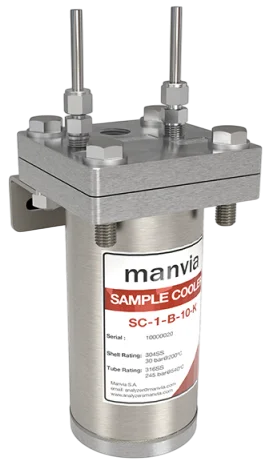
Sample cooler provides the most cooling efficiency allowing it to be suitable for most applications in liquid, gas or steam process. All the materials are constructed in stainless steel which provides rugged and longer life span. From standard 0.11 to 0.45 m2 heat exchange area is providing the most flexible usage for different applications. The removable shell design can be easy maintenance and cleaning after period of usage. For the applications of corrosive environment, other materials are available upon request, please consult factory. Dual helical coil design, providing maximum heat exchange area. Compact design minimizes cooling water needs. Removable outer Shell enclosure, providing easy maintenance and clean. No welded parts in sample tubing. Pass through fittings. Highest efficiency sample cooler commercially available. Exotic materials, such as titanium, Inconel® and Hastelloy® on the tube side and Monel® cupronickel and stainless steel on the shell side are available
Applications
Technical Specifications
Models & Variants

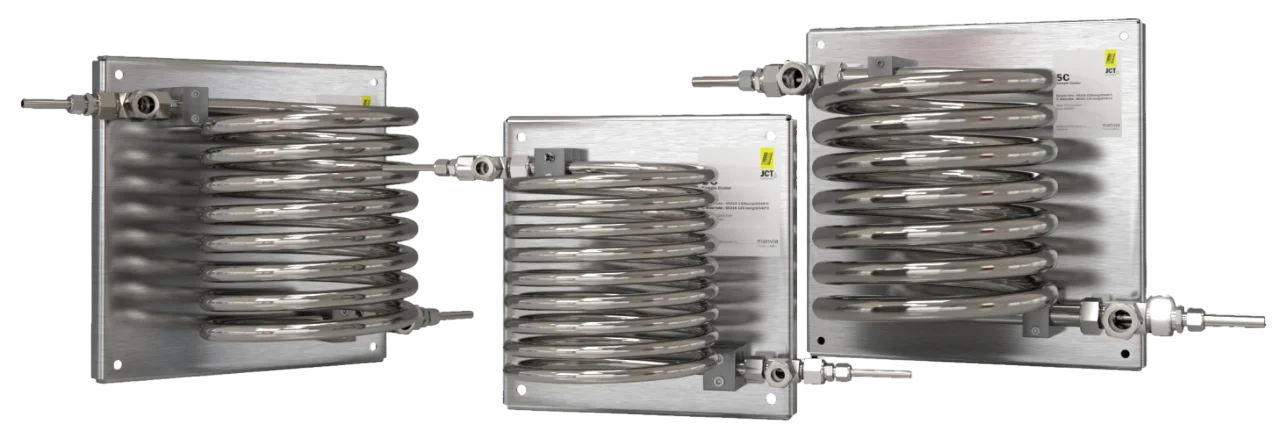
Fully drainable inner and outer coil. Constant velocity in the fluid. No joints gaskets or welded parts. Mounting in plate. Can be manufactured in special alloys. Without cavities or dead spots. Variable connection technology.
Applications

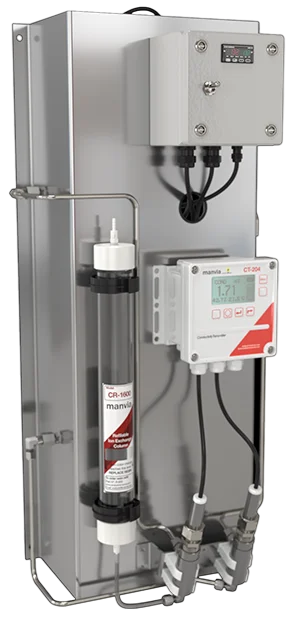
Cation exchange columns CR-600 / CR-1600, constitute, by their geometry, manufacturing materials and design, the ideal container for the performing of any necessary cation exchange. This operation, has a high importance, in order to get a reliable cationic conductivity (acid conductivity) measurement in sampling and analysis systems for steam/water cycle plants. The specific design of these columns, allows a right distribution of the flow through the cross section of itself. This allows, together with the type of resin used, an excellent contact between the fluid and the surface of the different resin beads, avoiding the formation of preferential paths that can affect the performance of this exchange. In addition, the columns, together with the resin supplied with them, provide an exchange bed with the necessary depth to ensure that the residence time of the fluid in it, is enough for a correct exchange. No PVC used. Clear polycarbonate tubes. Screw caps on both sides to facilitate filling and emptying. Response time 4 to 5 minutes (for a flow rate of 200 cc / min). Saturation indicator by color change. Regeneration with 5% HC.
Applications
Technical Specifications
Models & Variants

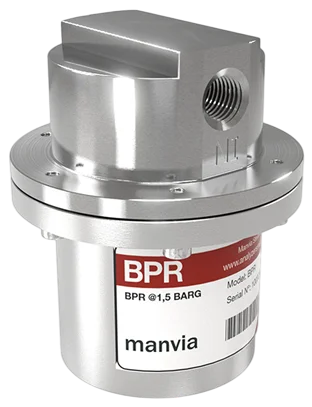
The Back Pressure Relief Valve is used to regulate upstream pressure in SWAS for analytical measurement sensors, maintain an constant inlet pressure before the analyzers which help stabilize the flow rate for each analyzer. When some analyzers are installed parallel for a same sample source, the back pressure relief valve can provide constant inlet pressure which allows all analyzers to be able to be shut off at all times without interrupting others.
Applications

The High Pressure Reducer valve is designed for high pressure (above 35 barg / 507 psig) boiler sampling lines, inlet pressure up to 350 barg (5076 psig) and outlet pressure totally adjustable. This type of pressure reducers are recommended by ASME-PTC 19.11. Rod-In-Tube Design. Designed for High Pressure up to 350 (5076 psig) barg. Design Temperature: 150°C (302 °F). Outlet pressure 1 to 20 barg. (14,5 to 290 psig) Adj. Higher Flow rate.
Applications

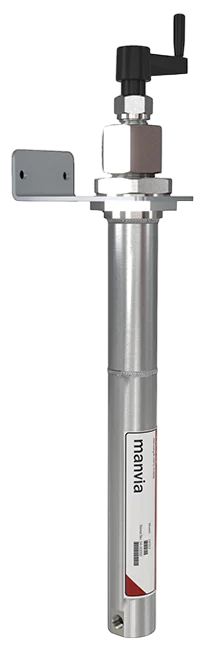
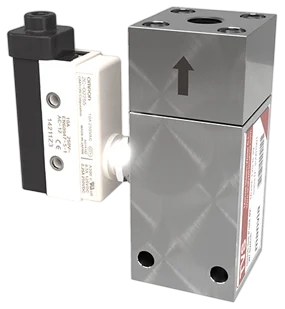
For process analyzers and similar instrumentation, it is important to assure that the ocess sample fluids are always below the maximum allowable temperature for such instruments, for it sample coolers are commonly used to reduce sample temperatures to the acceptable limits. In the event of a loss of cooling fluid to the sample cooler, or if the desired sample temperature is exceeded the operating temperature 49°C (120°F). The thermal actuator modulates the valve to close the inlet orifice to prevent equipment damage. It can incorporate a switch to send an alarm when it has been triggered. Automatically resets, no operator involvement required. No outside Power Source required. Rugged, compact design, easy installation, fast response. Operating temperatures unaffected by pressure. Corrosion resistant: all stainless steel 316L construction. Delivers superior value vs. more expensive electric valves. Maintenance free. Dry contact for remote alarm indication (optional).
Applications

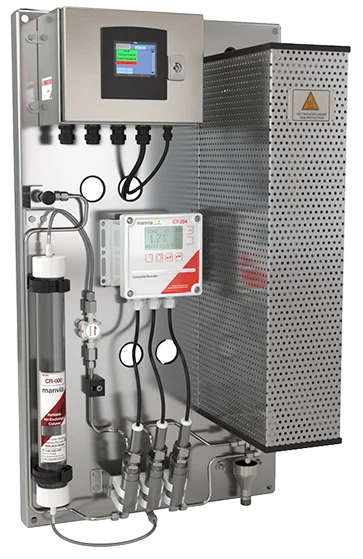
MANVIA DG-50 Degassing System, offers a new compact design for degassed conductivity measurement in water-steam cycle chemistry monitoring. This system ensures an effective COz removal from sample, by means of an accurate system boiler temperature control. Temperature control value inside system boiler, may be configured as function of environmental operation conditions, to get an exact boiling point control, without excessive energy be wasted. The system also provides appropriate temperature conditioning for an accurate degassed conductivity measurement. Furthermore, two sample cooling configurations are available: External cooling water heat exchanger and sample self-cooling exchanger. Due to optimal system performance, power production is maximized, while corrosion of production equipment is minimized. According with ASTM D4519 Provide with necessary shell protection to prevent operators from hot injury. Compact wall mount design. CE Marking. Designed to install the cationic resin column, the transmitter and the conductivity probes in the same plate.
Applications

After subjecting the sample to boiling, releasing any gas what could be dissolved in sample, a cooling is performed at 25-35 ° C, and then the treated sample is introduced to a conductivity measurement cell. Atmospheric pressure compensation of boiling point is performed automatically, in order to carry out a correct sample degassing with minimum energy wasting. Degassed cationic conductivity, is an important parameter for the boiler and turbine, most turbine manufacturers have specified that the value of the cation conductivity in the steam, must be below a certain limit of conductivity (less than 0.5 uS/cm), to avoid damage to the turbine. Including all necessary components as a complete unit, just piping, plug-in and ready to use. Provide with necessary shell protection to prevent operators from hot injury. Compact wall mount design. Flow indication. Switch protection No Flow CE Marking. Designed to install the cationic resin column, the transmitter and the conductivity probes in the same plate.
Applications

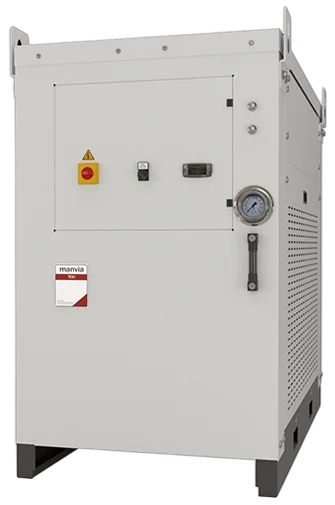
Designed to stabilize the temperature in a second stage of the samples in analyzer systems. A temperature control unit (TCU) systems are pre-designed available in standard sizes from 3 to 10 tons (others capacities available). Condenser water stainless steel heat exchanger Thermostatic valve for regulating the pressure of condensation water Self-contained with all necessary controls, pumping and refrigeration systems. Local display provides quick operational snapshot.
Applications

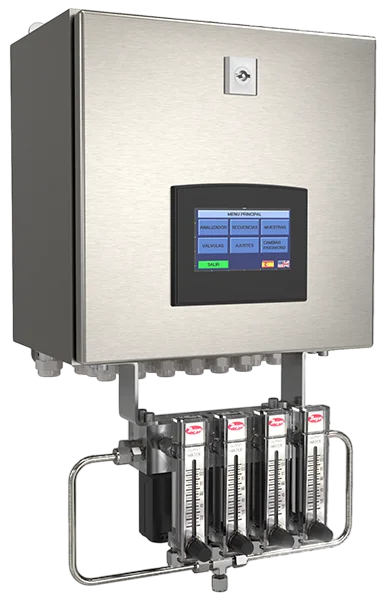
The multi-sample sequencer system, designed by Manvia, allows measuring up to 8 samples in two different analyzers. It can operate with continuous measurement or batch mode analyzers. It offers the whole system integrated in a single equipment, reducing the electrical interconnection, and the tubing work by 75%. Its configuration variables allows adapting to the actual samples needed (from 2 to 8).
Applications
Technical Specifications
Models & Variants

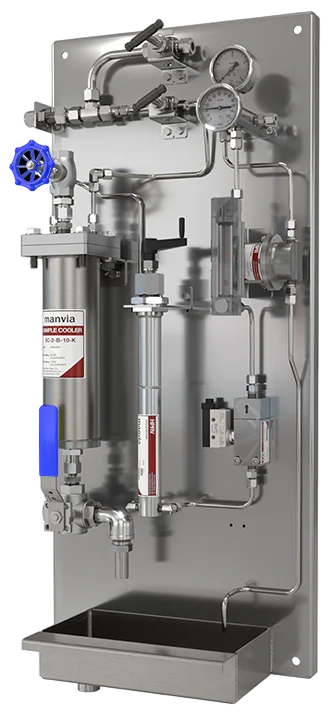
The Manvia sample conditioning compact panel is designed to condition any type of steam-water sample. This compact pre-tubed assembly allows analyzing the sample under optimal conditions. It only requires connection of the sample, drain and cooling water supply. Built according ASME PTC-19.11. Wetted parts: 316 stainless steel Pressure and temperature ratings 240 barg @ 540 °C (3480,9 psi(g) @ 1004°F). (higher on request) Sample flow up to 100 L/h (21,9 gal/h). (higher on request). Constant flow and pressure assured in analyzers, through back pressure and pressure regulating valve tandem. Portable. Expandable: Customizable with incorporation of specific conductivity, cation conductivity, pH and dissolved oxygen analyzers in one panel.
Applications

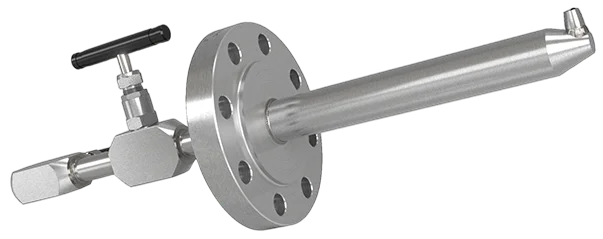
Isokinetic Steam Sampling Probes are used to obtain a representative sample from the saturated and superheated steam An appropriate analysis system starts with a correct sampling probe in process. If we do not take a representative sample process, we will never be able to have a reliable analysis system. This basic comment is sometimes undervalued in projects We can spend large amounts of money buving analyzers or conditioning systems, but if we don't have the right process sampling probe, probably we won't get the expected results. The Isokinetic probes requires that the velocity of the fluid entering in the sample nozzle is exactly the same as the velocity of the streaming being sampled at the location of sample nozzle The bore of the nozzle and the size of the port shall be in accordance with calculated data (IECTR61831 or ASME D1066 and PTC19.11). Each Isokinetic probe must be designed taking in account temperature, stresses, pressure, vibration, erosion, and strength of the attachment to the pipe.
Applications

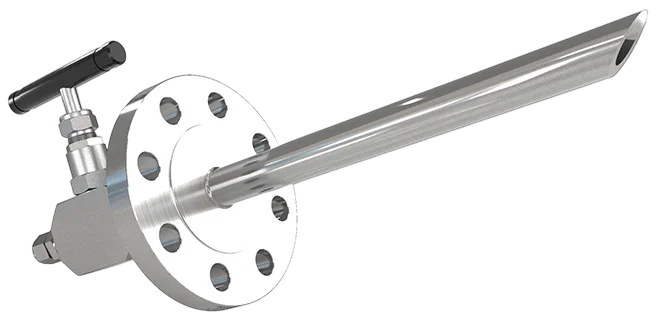
The standard probes, welded typically are constructed of pipe or heavy-wall tubing and are welded to a flange, to install on process. This type of probes are very resistant to temperature, stresses, pressure, vibration and erosion. However, because welded probes cannot be removed while the process is active, they are more difficult to maintain. Their larger size also decreases flow speed, allowing more particulate to fall out of the sample. However, decreased flow speed and increased volume may lead to increased time delay to the analyzer. Are appropriate to liquids or low-pressure gases.